The story about
Marjorie Bussey
Marjorie Bussey (1937 – ) was born in Bunbury, Western Australia to migrant parents Ivy and Joseph ‘Wilf’ Pritchard, who had travelled to Australia to take part in the now notorious Group Settlement Scheme. Both Ivy and Wilf were intelligent, well-read and deeply interested in radical ideas and new philosophies. Wilf was an artist whose religious convictions had seen him incarcerated as a conscientious objector for the duration of World War One. Ivy was a writer and a natural storyteller, who was published regularly in the West Australian under the pseudonym ‘Frolic’. Together they had six children (Joyce, Kitty, Basil, Phillip, Ben and Marjorie) five of whom survived to adulthood (Kitty died in 1925).
Born the year after Ivy and Wilf left the Group Settlement Scheme, Marjorie grew up listening to tales of frustration, injustice and resistance that characterised her parents fifteen years fighting for and eventually failing in, their great dream of a utopian society in the bush. Defeated by maddening bureaucracy and small-time corruption, the Pritchard’s eventually settled in Perth with five children in tow.
Wilf died in 1948, a year after his first exhibition in Perth, leaving Ivy with little financial support. As with many women of the era, Ivy remarried for very practical reasons, moving to a wheat and sheep farm on the Mallee in Victoria with Hermann Willersdorf and his children. Marjorie, being the youngest, travelled with her leaving behind her siblings and journeying into what she later describes as a ‘wilderness’.
From a chaotic, creative family, she found herself in a patriarchal community where the guidelines of existence were defined by the seasons and the gender.
Marjorie turned to the land, which became her sense of place and identity. She writes:
“I loved it with a passion; the red earth, the dust storms, the infinite spaces – memory organised itself into cameos and sensory awakenings. The conflict and aloneness were offset by a heightened awareness, which expanded the secret world of imagination and identity and influenced a lifetime of perceptions”.
Despite this passionate connection, her home life was less than ideal, and at 15 she was put on a train to Melbourne to enrol in the Associate Diploma of Art at RMIT University. Graduating in 1958, Marjorie married Victor Bussey and, after the birth of her first child, returned to Perth with her husband and baby.
Marjorie is a prolific artist and over the next 40 years had over 50 solo and group exhibitions with work held in a number of collections including the National Gallery of Australia and the Western Australian Art Gallery. In the late 1960s, she started working part-time at Perth Technical College lecturing in drawing.
Throughout her life, including her involvement in environmental issues, with the Artemis Woman’s Art Forum, and her studies which culminated in an Honours in Visual Art (2000), Marjorie has a definite philosophy towards her own work.
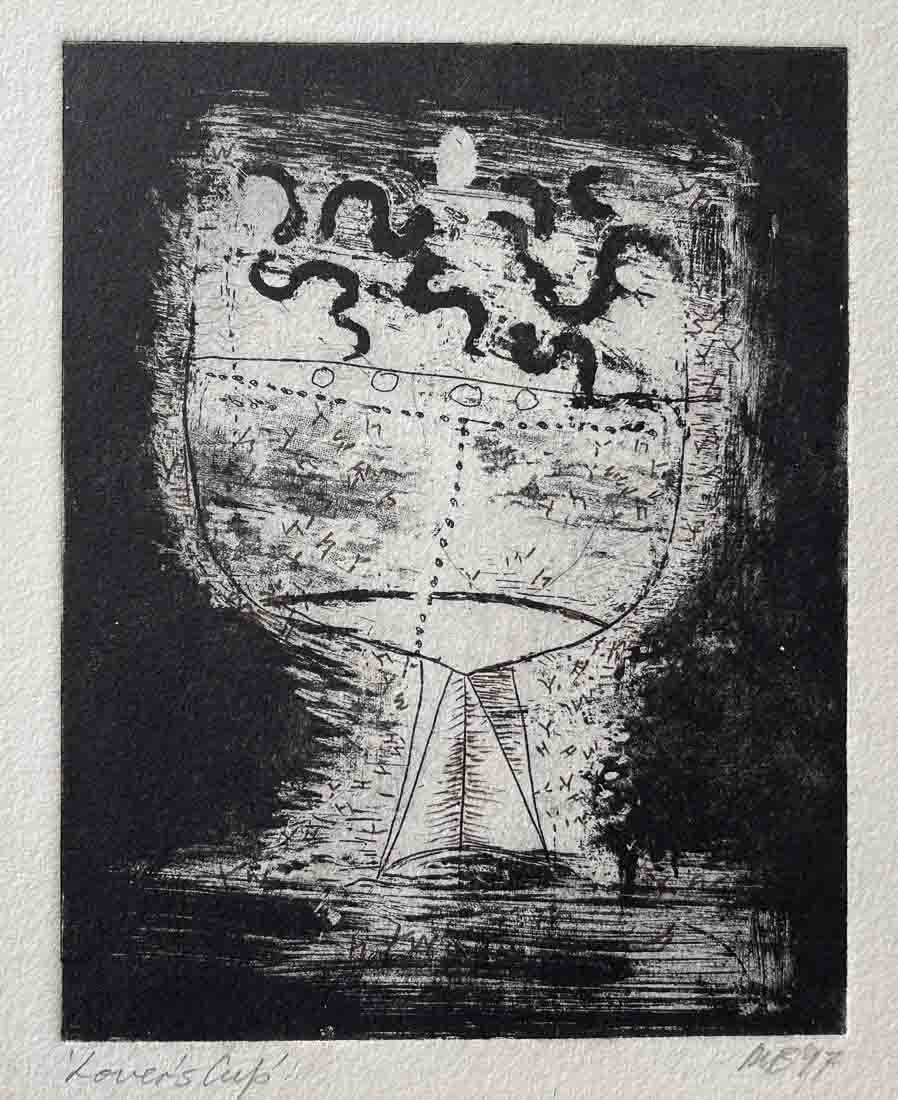
She refuses to over-analyse or pre-determine her work. She allows intuition to direct her and looks for the energy and myth inherent in the land. When Marjorie sees tress, she will paint the wind that blows them. The result is a painting of movement and feeling – the energy of the landscape, not merely a representational view.
In an interview by the West Australian newspaper in 1983 Marjorie explains:
“In many ways I feel like Alice perpetually falling down rabbit holes into the world as real as the one we wear as a skin.
The journey through this land is not only one of self-realisation but also of recording the effect of the creative force upon the human spirit.
The land, whose mystical presence seems to breathe life into every stone and mark upon its surface, manifests itself in the shape of mythical creatures. The feeling of timelessness presents itself in multitudinous images, past, present and future, all existing simultaneously like cave paintings on the wall of time.
This is the way in which I paint. This is how I feel about what I am trying to say. It is more of a sensation than anything; but the marks and patterns of the Australian land, and the feeling of its space and the impression of a world impregnated with ageless myths, is something of which I am very conscious.”
She and Victor have four children (Marcus, Meegan, Francesca and Chiara) and nine grandchildren.
Marjorie now lives in Melbourne, Victoria. Her husband Victor of over 60 years, paints alongside her.